It hears what a teacher hears.
Piano practice with a teacher or without
Musalea listens to every run on your digital piano and tells you what to practise next: the bar, the hand, the step. Its ear is calibrated on 705 performances by real pianists. Then play with a band and a soloist, through your own sounds, in the Method or with your own scores.
14 practice days · everything unlocked · no card
You need a digital piano or MIDI keyboard, and a Windows PC or a Mac.
Hear a run. Read what it wrote at the end.
Each run is one of the Method's own pieces, played with mistakes we made on purpose and graded by the app's own grader. Press play: each note takes the colour the app gave it as it sounds. The report opens when the run ends.
What the app wrote opens here when the run ends.
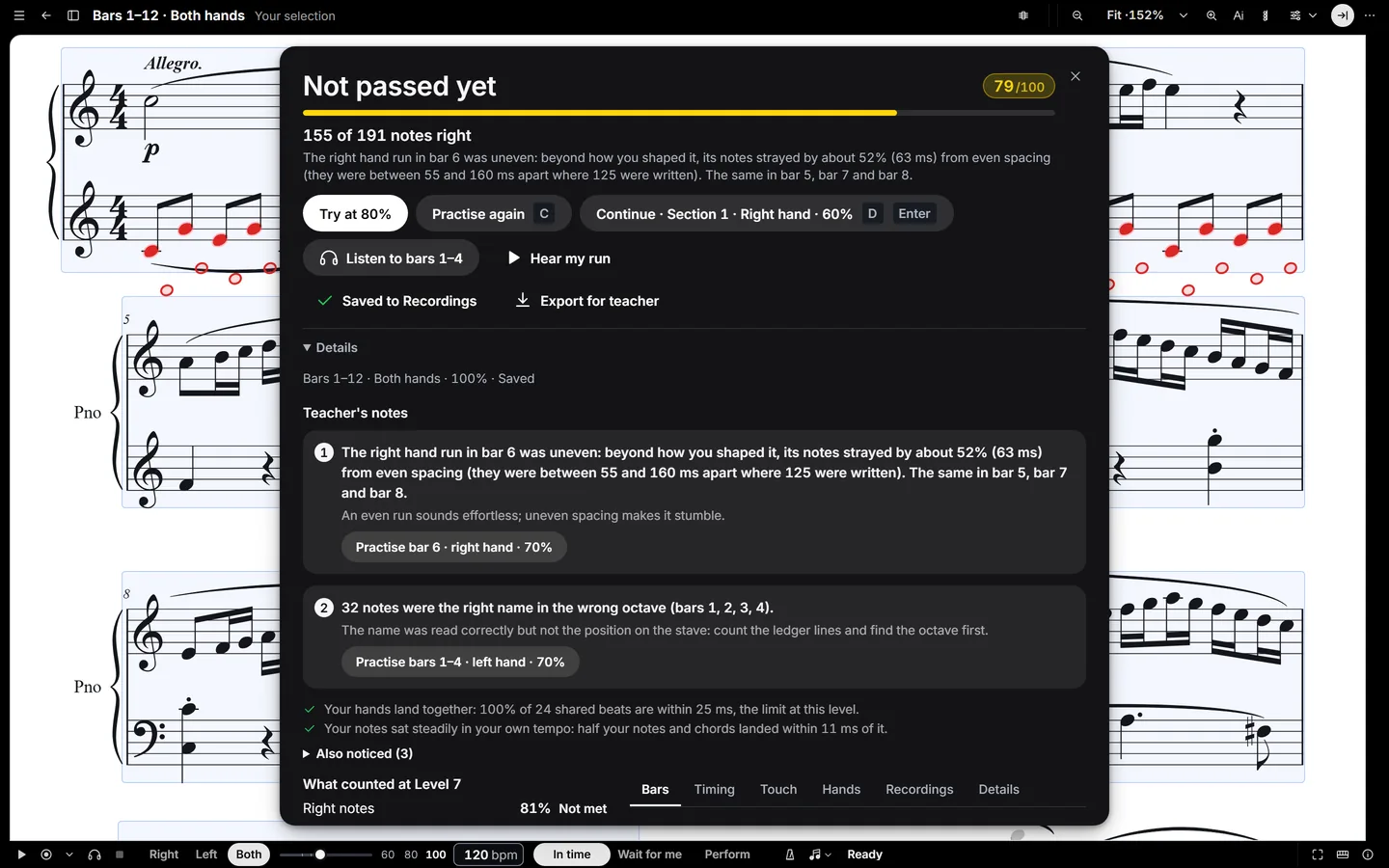
Not passed yet
Bars 1–12 · Both hands · 100% · Saved
The right hand run in bar 6 was uneven: beyond how you shaped it, its notes strayed by about 52% (63 ms) from even spacing (they were between 55 and 160 ms apart where 125 were written). The same in bar 5, bar 7 and bar 8.
An even run sounds effortless; uneven spacing makes it stumble.
Practise bar 6 · right hand · 70%
32 notes were the right name in the wrong octave (bars 1, 2, 3, 4).
The name was read correctly but not the position on the stave: count the ledger lines and find the octave first.
Practise bars 1–4 · left hand · 70%
Also noticed
- In bar 5 the right hand paused and then ran late: the notes were right, but each came about 1308 ms behind its beat.
- In bars 6–8 you hurried: your tempo ran about 15% faster than in the bars around them, and nothing in the score asks for it.
- From p to f in bars 10–11 the right hand did not change: it stayed at the same strength, where about 11 points on your own range would make the change heard.
155 of 191 notes right
On the score, notes were marked as follows: 34 wrong or far off time, 11 a little early or late, 2 missed, 2 held too short or too long.
What we played wrong on purpose
- In bars 1–4 the left hand plays its Alberti figure an octave too low.Found: note 2
- Just before the top of the first scale, in bar 5, the music stops for more than a second.Found: also noticed
- The scales limp: every second sixteenth comes late.Found: note 1
- After the stop the scales hurry to make the time up, about a sixth faster than the bars around them.Found: also noticed
- The forte in bar 11 is played as softly as the piano before it.Found: also noticed
A performance built from the score with deliberate mistakes, played into Musalea as a MIDI keyboard and graded by the app; the report and the marks are the app’s own for this run.
What the app wrote opens here when the run ends.
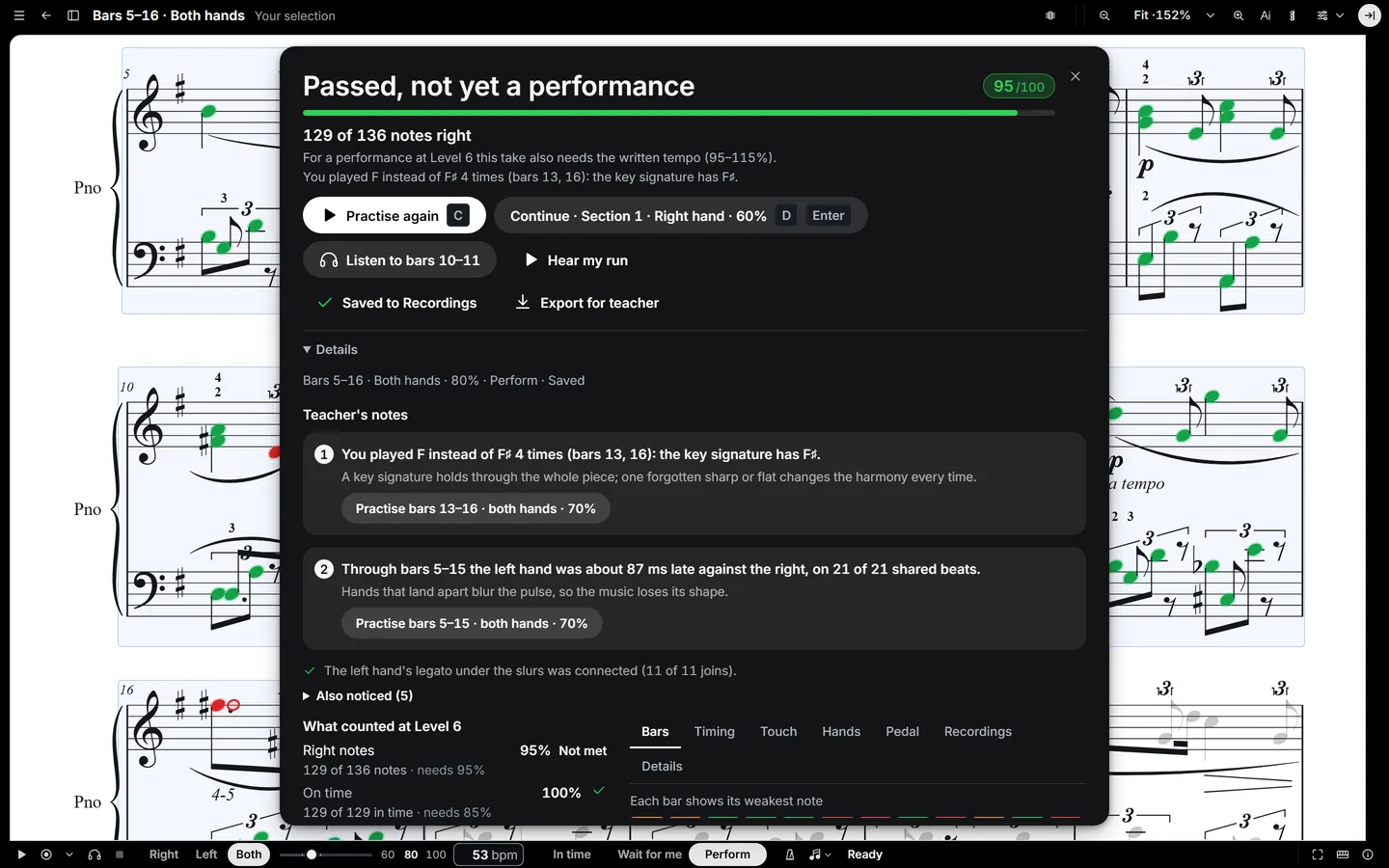
Passed, not yet a performance
Bars 5–16 · Both hands · 80% · Perform · Saved
You played F instead of F♯ 4 times (bars 13, 16): the key signature has F♯.
A key signature holds through the whole piece; one forgotten sharp or flat changes the harmony every time.
Practise bars 13–16 · both hands · 70%
Through bars 5–15 the left hand was about 87 ms late against the right, on 21 of 21 shared beats.
Hands that land apart blur the pulse, so the music loses its shape.
Practise bars 5–15 · both hands · 70%
Also noticed
- The right hand had 3 wrong or missed notes in bars 10, 11: the notes are not yet secure there.
- Under the slur in bars 5–8 the right hand left gaps of about 454 ms between 7 of 7 notes: the legato broke. The same in bars 14–16.
- In the right-hand chords of bars 9–12 the top note was about 9 points softer than the notes under it; the melody needs to be about 8 above them.
- The ritard. in bar 13 was not shaped: the tempo changed by 0% (it should slow by at least 5%).
- The fermata in bar 14 was held 1.0 times its written length: a pause should be felt.
129 of 136 notes right
On the score, notes were marked as follows: 5 held too short or too long, 3 missed, 4 wrong or far off time.
What we played wrong on purpose
- Under the slurs the melody’s keys come up early, leaving gaps between its notes.Found: also noticed
- The left hand lands about 85 ms after the right throughout.Found: note 2
- In bars 9–12 the melody is played more softly than the notes under it.Found: also noticed
- Three of the right hand’s inner triplet notes in bars 10–11 are left out.Found: also noticed
- From bar 13 the F♯ of the key signature is played as F natural.Found: note 1
- The ritard. in bar 13 is not taken: the tempo runs on unchanged.Found: also noticed
- The fermata in bar 14 is let go at its written length and the music goes straight on.Found: also noticed
A performance built from the score with deliberate mistakes, played into Musalea as a MIDI keyboard and graded by the app; the report and the marks are the app’s own for this run.
What the app wrote opens here when the run ends.
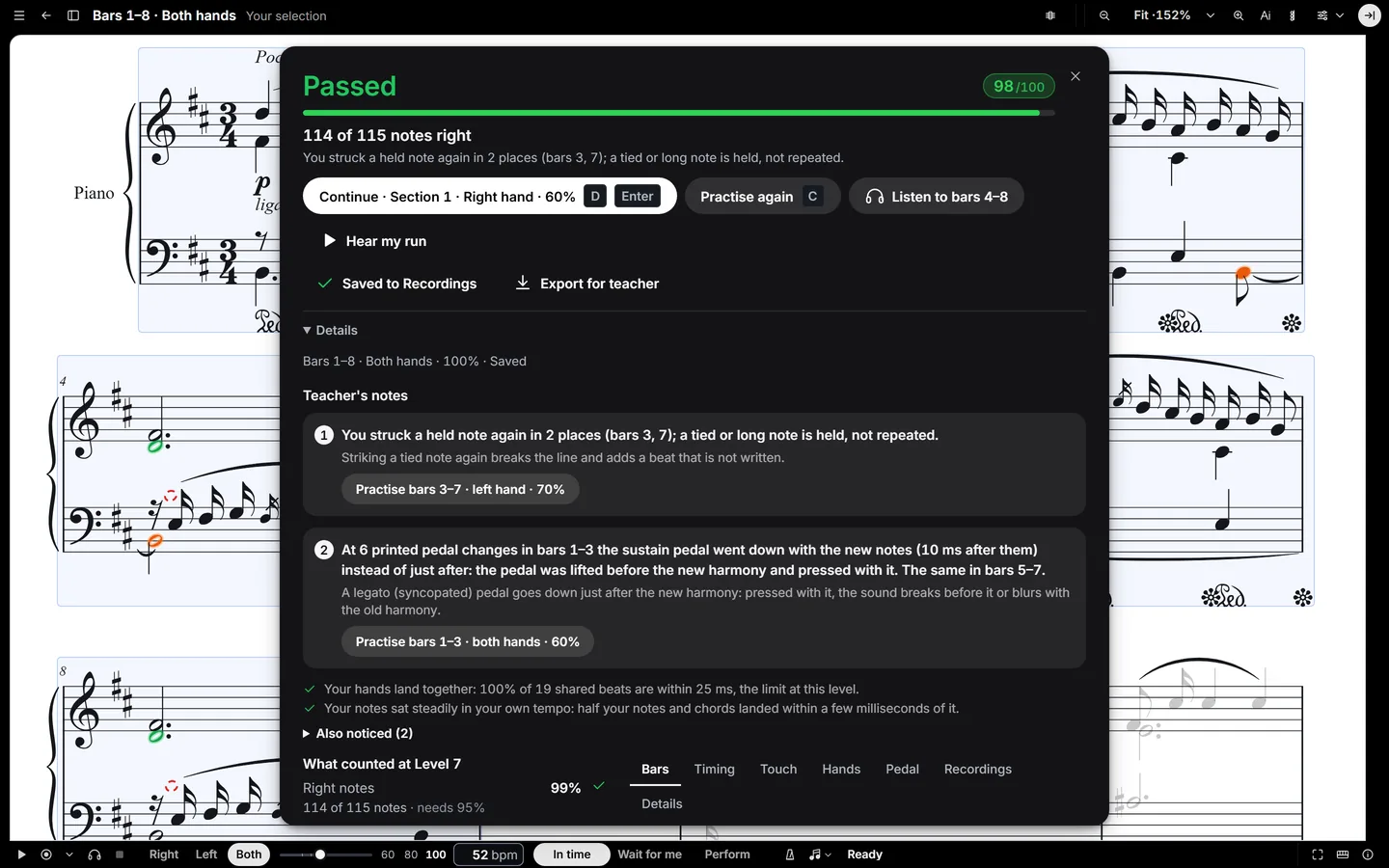
It passed: 114 of 115 notes right. It still found two things to fix.
Passed
Bars 1–8 · Both hands · 100% · Saved
You struck a held note again in 2 places (bars 3, 7); a tied or long note is held, not repeated.
Striking a tied note again breaks the line and adds a beat that is not written.
Practise bars 3–7 · left hand · 70%
At 6 printed pedal changes in bars 1–3 the sustain pedal went down with the new notes (10 ms after them) instead of just after: the pedal was lifted before the new harmony and pressed with it. The same in bars 5–7.
A legato (syncopated) pedal goes down just after the new harmony: pressed with it, the sound breaks before it or blurs with the old harmony.
Practise bars 1–3 · both hands · 60%
Also noticed
- The final note was held only 35% of its length.
- In the right hand you played A4 instead of A♯4 in bar 5.
114 of 115 notes right
On the score, notes were marked as follows: 1 held too short or too long, 1 wrong or far off time.
What we played wrong on purpose
- At each printed pedal change the pedal comes up before the new harmony and goes down with its notes.Found: note 2
- The left hand strikes its tied B again at the start of bars 4 and 8 instead of holding it.Found: note 1
- A is played instead of A♯ in the turn of bar 5.Found: also noticed
- The last bass note is let go after about a third of its length.Found: also noticed
A performance built from the score with deliberate mistakes, played into Musalea as a MIDI keyboard and graded by the app; the report and the marks are the app’s own for this run.
It listens for what a teacher listens for.
Right notes are where it starts. From the MIDI your keyboard sends, timed by the keyboard's own timestamps, Musalea follows how you play the music.
Legato
Whether the notes under a slur join, and where a gap breaks the line.
Fermatas and tempo words
A fermata held, a ritardando where one is written, rubato, and coming back in tempo.
Melody and voicing
The melody above its accompaniment, and the top voice of each chord.
Dynamics and accents
Printed dynamics and hairpins against the range of your own touch; accents and staccato.
Pedal
Sustain, soft and middle pedal changes, against the harmony and the printed marks.
Evenness
Even runs and an even touch, note after note.
Hands together
Each hand against the other, and how far a chord spreads.
Pulse
A steady beat: where you rush and where you drag.
Held notes
How long each note sounds against its written length.
Continuity
Stops, restarts and how you recover.
Swing
Swing graded as swing: the off-beats count where the groove puts them.
Calibrated on 705 performances. The engine is checked and tuned against 705 performances aligned to the app's own scores, 574 of them played on keyboards by competition, conservatory and concert pianists.
The whole app, in a short film.
A run and its report, a band and a soloist in Changes, and the Method from Foundation to Fellowship and Concert.
Grading that grows with you.
The same run is judged differently at Level 2 and at Diploma, and each lesson listens hardest for what it teaches.
- Windows that tighten with your level. Timing is judged in proportion to the music: at Level 5, with a quarter note at 80, a sixteenth may land 30 ms early or late, a quarter note 60 ms. The room shrinks as your level rises.
- Each lesson weighs its skill. A fifth of a lesson's mark goes to the skill it teaches, from pedalling to voicing.
- Tuned to your keyboard. You play five steps from softest to loudest once; a printed p or f is judged against your own touch.
- A teacher's report. It names the bar and the hand, says why it matters, and offers a practice step in one tap, often at a slower tempo.
- A smaller step when it is hard. When a passage keeps giving you trouble, the next step gets smaller: fewer bars, one hand, a slower tempo.
Bring your chords. A band and a soloist play them with you.
Changes plays your chord progression with a real band in any key and at any tempo. A piano, guitar or saxophone soloist develops every chorus, trades 2, 4 or 8 bars with you, answers in your gaps or plays behind you. Then turn any of it into piano practice packs.
Your sounds, your routing.
Your piano, the band and the soloist each go to the sound you choose, each on its own channel with its own delay.
Piano: Pianoteq 9 by Modartt, NY Steinway D Classical preset. Licences and credits
- Your pianoThe built-in piano, any MIDI instrument, Pianoteq or a DAW
- The bandThe app's recorded instruments, any MIDI instrument or a DAW
- The soloistIts built-in piano, guitar or saxophone, any MIDI instrument or a DAW
The piece on your stand, turned into lessons.
Import MusicXML, MIDI or MuseScore files. Musalea cuts the piece into sections, builds a practice path, makes exercises from its hardest bars and writes the same report after each run as in the Method.
- Each sectionRight hand, left hand, then both
- TempoEach passage climbs tempo steps up to the written tempo, set for the piece and your level, or any tempo you type.
- Hard spotsExercises made from the piece's hardest bars
- JoinsSections joined, so the seams hold
- PerformThe whole piece, from start to finish

Your scores stay private to your account: never sold, shared or published.
From your first lesson to a Beethoven concerto, with the orchestra.
Diploma: Beethoven's Third Concerto, first movement, with the app playing the orchestra. Licentiate and Concert: Chopin's First Concerto, the first movement and then the whole concerto.

Fourteen levels, four strands
157 lessons, each built around a piece: published repertoire, unarranged, or one of the 52 pieces written for the Method. 1,575 pieces in all, 1,523 of them public-domain, CC0 or CC BY editions.
Pieces
Published repertoire and pieces written for the Method, each learned section by section up to a performance.
Technique
302 technique items, with a warm-up in the key of each piece.
Reading
Graded sight-reading at every level, with a first-sight reading test.
Musicianship
157 units of theory questions, ear training, rhythm reading and keyboard harmony, answered at the piano.
 Foundation
 Level 1
 Level 2
 Level 3
 Level 4
 Level 5
 Level 6
 Level 7
 Level 8
 Level 9
 Level 10
 DiplomaA recital programme at undergraduate standard, with Beethoven's Piano Concerto No. 3 (first movement) and the app playing the orchestra.
 LicentiateConcert repertoire, with analysis of every programme work and the first movement of Chopin's Piano Concerto No. 1.
 Fellowship and ConcertOpen-ended concert tiers, with Chopin's Piano Concerto No. 1 complete.
Each level gives its approximate ABRSM, Trinity and RCM equivalents.
Choose what to practise, or let Musalea plan the day.
Work through any strand of the Method as you choose, or start today's session: Musalea fits the parts you want into the minutes you have, each at its own level.
Choose a strand
Open the Method and pick Pieces, Technique, Reading or Musicianship, at any level and in any order. Each strand climbs its own ladder, so your reading can be ahead of your pieces. Between runs, D on the piano goes on to the next step.
Start today's session
Press Start session on Home and Musalea plans the time you have: a warm-up, your parts in rounds and a short closing replay. A bar follows you through the app with the part you are in, the time left in it and what comes next.
- Your length. 15, 30, 45, 60, 90 or 120 minutes, or any length from 10 to 240. The warm-up, the closing replay and any rests fit inside it.
- Each part at its own level. Technique, études, pieces, reading, musicianship and review, as you choose. What comes next is the same as in the Method, so a session and your lessons never disagree.
- Careful pacing. If you want it: 20-minute stretches with 10-minute rests. Musalea never decides it for you.
- Between parts. A part never ends in the middle of a run. Add 5 minutes, skip a part, or change the order and the minutes as you go.
- Continue. Close the app and the session waits for you; Continue on Home picks up where you left off.
- No streaks. The last 14 days show your minutes and, with a daily goal, the days that reached it. A missed day costs nothing.

Theory where you play it.
251 ideas on 257 short cards, each shown when a piece first needs it, and 186 deep dives, most of them playing the idea in real pieces. Hear a change of key, then play a cadence in it.

Your hands stay on the keys.
Between runs, the piano runs the app. One white key played on its own is a command in any octave: D goes on to the next step, C practises again. The pedals work as commands too.
A, Listen, plays the passage to you the way a pianist would: the printed dynamics, the pedal, the articulation and phrasing, a ritardando where one is written and the melody over the accompaniment, with the band or the orchestra when the piece has one. Swing pieces are played swung.
- C: Practise
- D: Go on
- E: Back
- F: Slower
- G: Faster
- A: Listen
- B: Hands
Every run kept, ready for your lesson.
Progress is shown level by level and part by part, from what you actually played. A missed day costs nothing.

- Your recordings. Listen back to your recent takes and compare one with the one before.
- For your teacher. Export what you have played and bring it to your lesson.
- In English and Spanish. The app, the Method and every report, in either language.
Start where you are.
Foundation or Diploma, a book you finished years ago or the piece on your stand today.
- Everything unlocked. Every level and every feature.
- 14 practice days. Within 60 days; a day counts once the app has been open for 5 minutes that day.
- No card. The app reminds you in your last three days.
You need a digital piano or MIDI keyboard, and a Windows PC or a Mac.