The Method, from the first note to the concert platform
Every level of the Method in Musalea, in the order the app teaches it, from Foundation to Fellowship and Concert. Four strands climb the levels side by side: pieces, technique, reading and musicianship.
14 levels · 157 lessons · 157 Musicianship units · 257 theory cards · 302 technique items · 1,575 pieces, 52 written for the Method
Four strands, each on its own ladder
- PiecesThe lessons, 157 in all, each an idea and its piece; 1,575 pieces in the Library.
- Technique302 technique items: scales, arpeggios, chords and exercises, each with its own tempo up to the target.
- ReadingUnseen pieces read once at first sight, a reading score out of 100 and a reading test you can take at any time.
- Musicianship157 Musicianship units: theory questions, ear training, rhythm reading and keyboard harmony.
- GlossaryEvery idea of the theory cards: what it means, its related ideas and the lessons that teach it.
How to read the Method
Each level opens with what it is for, the exam grades it roughly matches, how long it usually takes and what is new in it. Its lessons follow in order, numbered by level and place: F.3 is the third lesson of Foundation, 5.2 the second lesson of Level 5.
A lesson pairs an idea with one piece, in five steps, the way the app plays them:
- New idea. The lesson’s theory cards, each just before the first practice that uses its idea. Their questions come in the level’s Musicianship.
- Warm-up. One short exercise in the key of the piece (a five-finger pattern, a scale or an arpeggio): right hand, left hand, then both hands, slowly.
- The piece. The passages the lesson assigns, bar by bar: right hand, left hand, then both hands, each at 60, 80 and 100% of its tempo. Slower practice, at any tempo you type, is always there.
- Fix and polish. The hardest passages with both hands, then the joins between sections, then the whole piece up to tempo.
- Perform it. Where the lesson asks for it, the whole piece at full tempo, once through as a performance.
Four strands climb the 14 levels, each on its own: a strand moves up when it meets its own goal, and one can be far ahead of another. Practise any of them as you choose, or let the app plan today’s session, each strand at its own level.
Pieces are the lessons. Where a lesson offers alternatives, any one of them fills it; from Level 3 you may choose your own piece for each style, and the lesson’s idea stays the same.
Technique climbs its own ladder of scales, arpeggios, chords and exercises, each step with its own tempo up to the target.
Reading is music you have not seen: unseen pieces in rounds of 4, each read once without stopping, and a reading test you can take at any time, which finds your reading level phrase by phrase.
Musicianship comes in units, one beside each lesson: theory questions from the level’s cards, ear training, rhythm reading and keyboard harmony (cadences, chords under a melody, lead-sheet voicings, figured bass).
Each level closes with a Level check, judged like a conservatory exam. Your hands stay on the keys: between runs, C on the piano repeats a block and D goes on.
The styles are named as in the app: Baroque · Classical · Romantic · Modern, jazz and dance · Studies. Beside the styles, Changes plays your chord progression with a band in any key and tempo, and a piano, guitar or saxophone soloist that develops each chorus and trades bars with you; any of it becomes piano practice.
The 14 levels
-
Claude Monet, Water Lilies Foundation
Your first months at the piano: the keyboard map, steady pulse, reading by landmarks and intervals, and short pieces from the first week, two of them duets where the app plays the other part.
- Roughly
- RCM Prep A–B · ABRSM Initial · Trinity Initial
- Usually
- 2–3 months
- In the Method
- 13 lessons · 13 Musicianship units · 30 theory cards · 12 technique items
- In the Library
- 42 pieces at this level
- New
- Keyboard landmarks and finger numbers
- Pulse; quarter, half and whole notes; ties and dots; 4/4 and 3/4
- The grand staff; steps and skips
- Dynamics, staccato, legato and accents
- The damper pedal with the note
- C and G five-finger positions
- The tonic and dominant chords
- Pieces include
- Aller Anfang ist schwer (Every Beginning Is Difficult), Handstücke I No. 1, Daniel Gottlob Türk
- The First Lessons, Op. 117 No. 1, Cornelius Gurlitt
- Vorschule im Klavierspiel, Op. 101 No. 11 — Der Kuckuck (The Cuckoo), Ferdinand Beyer
-
Katsushika Hokusai, Cranes on snow-covered pine Level 1
Hands together in simple textures, eighth notes and key signatures, your first two-voice pieces, and harmonizing a melody with I and V.
- Roughly
- RCM 1 · ABRSM 1 · Trinity 1 · Henle 1
- Usually
- 3–4 months
- In the Method
- 12 lessons · 12 Musicianship units · 21 theory cards · 12 technique items
- In the Library
- 25 pieces at this level
- New
- Eighth notes and the upbeat
- Key signatures: G and F major (a few pieces already use others)
- Intervals by size
- Two-octave scales hands separately, tetrachords and the chromatic scale
- Two independent voices
- Binary form and the fermata
- Harmonizing with I and V7
- Pieces include
- Melody in C major, ABC du piano No. 14, Félix Le Couppey
- The Chase (Die Jagd), Op. 117 No. 15, Cornelius Gurlitt
- Song Tune in C major, ZT 694, Henry Purcell
- Allegretto, Op. 1 No. 5, Alexander Reinagle
-
Alfred Sisley, A Turn in the Road Level 2
Dotted rhythms, triplets and sixteenths, minor keys, triads and their inversions, 6/8 time, and the legato pedal.
- Roughly
- RCM 2 · ABRSM 2 · Trinity 2 · Henle 1
- Usually
- 4–6 months
- In the Method
- 10 lessons · 10 Musicianship units · 25 theory cards · 22 technique items
- In the Library
- 55 pieces at this level
- New
- Dotted quarter and eighth; triplets; sixteenths
- Minor keys and the harmonic minor
- Triads and inversions
- 6/8 time; the acciaccatura
- Primary chords I–IV–V7; harmonizing a melody
- Legato (syncopated) pedal
- The minuet and trio
- Pieces include
- Minuet in D major, K. 94, Wolfgang Amadeus Mozart
- Soldiers’ March (Soldatenmarsch), Op. 68 No. 2, Robert Schumann
- Douce plainte, Op. 100 No. 16, Friedrich Burgmüller
- Aria in D minor “So oft ich meine Tobackspfeife”, BWV 515, Johann Sebastian Bach
-

Utagawa Hiroshige, Mishima: Morning Mist Level 3
The sonatina, Baroque dances and character pieces: compound time, syncopation, the dominant seventh, Alberti bass and ternary form.
- Roughly
- RCM 3 · ABRSM 3 · Trinity 3 · Henle 2
- Usually
- 6–8 months
- In the Method
- 10 lessons · 10 Musicianship units · 22 theory cards · 19 technique items
- In the Library
- 88 pieces at this level
- New
- Compound time with the pulse shared between the hands
- Syncopation
- Interval quality
- The dominant seventh
- Melodic minor; double dots and thirty-second notes
- Ternary form and simple sonatina form
- Alberti bass and balance
- Pieces include
- Sonatina in C major, Op. 136 No. 1: I. Allegro, Carl Reinecke
- La gracieuse, Op. 100 No. 8, Friedrich Burgmüller
- Album for the Young, Op. 39 No. 5: March of the Wooden Soldiers, Pyotr Ilyich Tchaikovsky
- Bagatelle in A minor, Op. 119 No. 9, Ludwig van Beethoven
-
Claude Monet, Cliff Walk at Pourville Level 4
Ornaments, arpeggios, inversions of V7, phrase and period, rondo, and voicing a melody above its accompaniment.
- Roughly
- RCM 4 · ABRSM 4 · Trinity 4 · Henle 2–3
- Usually
- 7–10 months
- In the Method
- 10 lessons · 10 Musicianship units · 17 theory cards · 23 technique items
- In the Library
- 118 pieces at this level
- New
- Ornaments: mordent, trill and turn
- The appoggiatura
- Inversions of V7
- Phrase and period
- Rondo
- Tonic arpeggios
- Voicing the melody
- Pieces include
- Ballade, Op. 100 No. 15, Friedrich Burgmüller
- Sonata in G major, Hob. XVI:8: III. Andante, Joseph Haydn
- Sonatina in C major, Op. 36 No. 1: III. Vivace, Muzio Clementi
- Bagatelle 'Lustig-Traurig', WoO 54, Ludwig van Beethoven
-
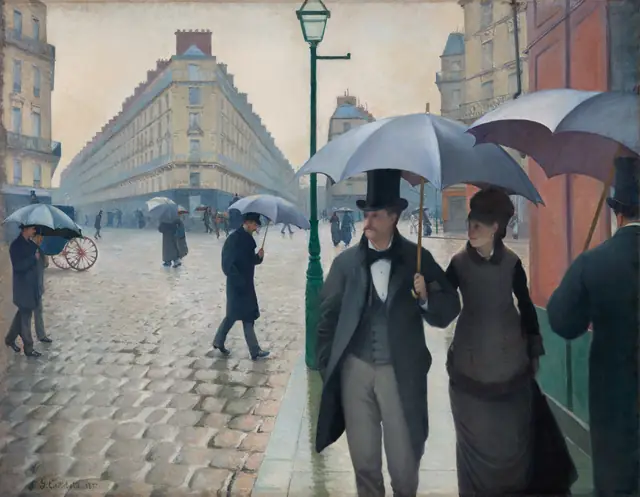
Gustave Caillebotte, Paris Street; Rainy Day Level 5
Two-part counterpoint, the circle of fifths, figured-bass basics and the first lead-sheet comping.
- Roughly
- RCM 5 · ABRSM 5 · Trinity 5 · Henle 3
- Usually
- 8–12 months
- In the Method
- 10 lessons · 10 Musicianship units · 25 theory cards · 27 technique items
- In the Library
- 150 pieces at this level
- New
- The circle of fifths
- Diatonic triads on every degree; the deceptive cadence
- Figured-bass numbers
- Two-part counterpoint and sequence
- Dominant seventh chords in the technique
- Lead-sheet comping
- Pieces include
- Invention No. 4 in D minor, BWV 775, Johann Sebastian Bach
- Dedicatoria, Op. 1 No. 1, Enrique Granados
- Waltz, Op. 12 No. 2, Edvard Grieg
- Prelude in A major, Op. 28 No. 7, Frédéric Chopin
-
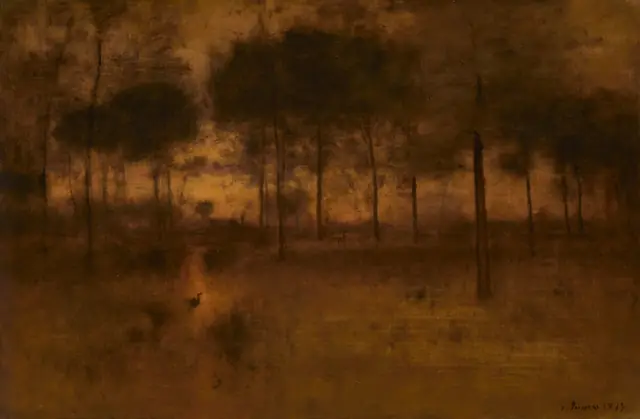
George Inness, The Home of the Heron Level 6
Seventh chords of every quality, modes and other scales, non-chord tones, hemiola, theme and variations and the Classical style in depth.
- Roughly
- RCM 6 · ABRSM 6 · Trinity 6 · Henle 4
- Usually
- 6–9 months
- In the Method
- 10 lessons · 10 Musicianship units · 21 theory cards · 20 technique items
- In the Library
- 100 pieces at this level
- New
- Seventh chords: all qualities
- The cadential six-four
- Non-chord tones
- Modes; pentatonic, whole-tone and blues scales
- Two against three; hemiola
- Theme and variations
- Ragtime form
- Half pedal
- Pieces include
- Sonatina in C major, Op. 20 No. 1: I. Allegro, Friedrich Kuhlau
- Von fremden Ländern und Menschen, Op. 15 No. 1, Robert Schumann
- Minuet in E-flat major, WoO 82, Ludwig van Beethoven
- Original Rags, Scott Joplin
-
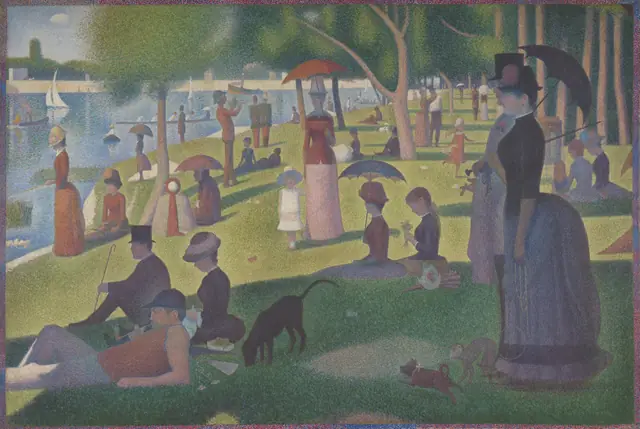
Georges Seurat, A Sunday on La Grande Jatte — 1884 Level 7
Inventions and sonata form, fugue vocabulary, modulation to related keys, Romantic style and rubato.
- Roughly
- RCM 7 · ABRSM 6 · Trinity 6–7 · Henle 4
- Usually
- 6–9 months
- In the Method
- 11 lessons · 11 Musicianship units · 17 theory cards · 26 technique items
- In the Library
- 191 pieces at this level
- New
- Modulation to related keys
- Sonata form
- Fugue vocabulary
- The diminished seventh
- Romantic style; rubato
- Early jazz harmony
- Four-note chords
- The rule of the octave
- Pieces include
- Invention No. 3 in D major, BWV 774, Johann Sebastian Bach
- Piano Sonata No. 20 in G major, Op. 49 No. 2: I. Allegro ma non troppo, Ludwig van Beethoven
- Für Elise (Bagatelle in A minor), WoO 59, Ludwig van Beethoven
- Prelude in E minor, Op. 28 No. 4, Frédéric Chopin
-
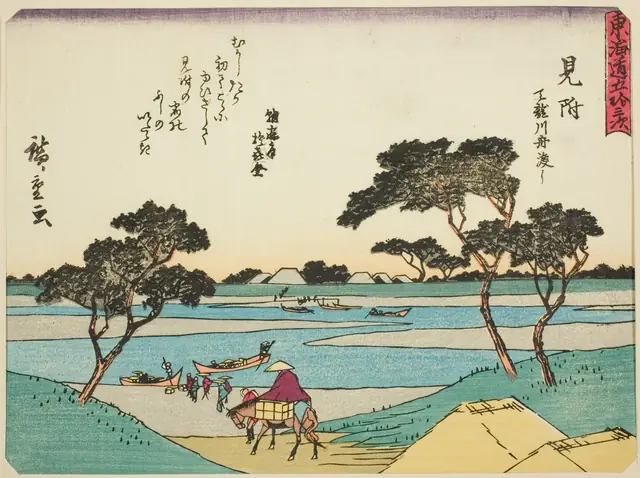
Utagawa Hiroshige, Mitsuke: Ferries Crossing the Tenryu River Level 8
The Classical sonata proper, four-part voice-leading, chorales and figured bass at the keyboard, galant schemas and four-octave technique.
- Roughly
- RCM 8 · ABRSM 7 · Trinity 7 · Henle 4–5
- Usually
- 12–18 months
- In the Method
- 11 lessons · 11 Musicianship units · 17 theory cards · 23 technique items
- In the Library
- 184 pieces at this level
- New
- Four-part voice-leading
- Chorale harmonization
- Figured bass at the keyboard
- Galant schemas
- Mode mixture
- Lead-sheet symbols
- Four-octave scales and arpeggios
- Pieces include
- Sinfonia No. 1 in C major, BWV 787, Johann Sebastian Bach
- Piano Sonata No. 19 in G minor, Op. 49 No. 1: II. Rondo: Allegro, in G major, Ludwig van Beethoven
- Moment musical in F minor, D. 780 No. 3, Franz Schubert
- The Art of Finger Dexterity, Op. 740 No. 37, Carl Czerny
-
Vincent van Gogh, The Bedroom Level 9
The first preludes and fugues, sonata movements, Romantic character pieces and études, extended chords and applied dominants.
- Roughly
- RCM 9 · ABRSM 8 · Trinity 8 · Henle 5–6
- Usually
- 15–20 months
- In the Method
- 10 lessons · 10 Musicianship units · 16 theory cards · 21 technique items
- In the Library
- 225 pieces at this level
- New
- Extended chords (9, 11, 13)
- Shell and rootless voicings
- Fugue structure in detail
- Applied (secondary) dominants
- Distant modulation
- Impressionist techniques
- Scales in octaves
- Three against four
- Pieces include
- Fugue in C major, BWV 846, Johann Sebastian Bach
- Piano Sonata No. 1 in F minor, Op. 2 No. 1: I. Allegro, Ludwig van Beethoven
- Première Arabesque, L. 66 No. 1, Claude Debussy
- Moment musical in A-flat major, D. 780 No. 6, Franz Schubert
-

Winslow Homer, The Water Fan Level 10
Preludes and fugues, sonata movements, Schubert impromptus and Chopin's larger pieces: the threshold of the diploma.
- Roughly
- RCM 10 · ABRSM after Grade 8 · Trinity after Grade 8 · Henle 6
- Usually
- 12–18 months
- In the Method
- 11 lessons · 11 Musicianship units · 13 theory cards · 35 technique items
- In the Library
- 151 pieces at this level
- New
- Enharmonic modulation
- Octatonic and polytonal writing
- Trio-sonata texture
- Analysing a sonata movement
- Stride and the twelve-bar blues
- Editions and urtext
- Scales a third and a sixth apart
- Pieces include
- Fugue in F major, BWV 856, Johann Sebastian Bach
- Sonata in C major, K. 309: I. Allegro con spirito, Wolfgang Amadeus Mozart
- Impromptu in C minor, D. 899 No. 1, Franz Schubert
- Clair de lune, L. 75 No. 3, Claude Debussy
-
Frederic Edwin Church, View of Cotopaxi Diploma
A recital programme at undergraduate standard: complete preludes and fugues and sonatas, a concerto movement with the app’s orchestra, études and character pieces, with a programme note and part played from memory.
- Roughly
- RCM ARCT · ABRSM ARSM · Trinity ATCL · Henle 7
- Usually
- 12–24 months
- In the Method
- 14 lessons · 14 Musicianship units · 12 theory cards · 20 technique items
- In the Library
- 147 pieces at this level
- New
- Schenkerian thinking (introduction)
- Historical performance practice
- Large-form analysis
- Programme notes
- The Neapolitan sixth
- Augmented sixth chords
- Pieces include
- Prelude and Fugue in F minor, BWV 857 — complete pair, Johann Sebastian Bach
- Piano Sonata No. 6 in F major, Op. 10 No. 2 — complete, Ludwig van Beethoven
- Piano Concerto No. 3 in C minor, Op. 37: I. Allegro con brio, Ludwig van Beethoven
- Intermezzo in A major, Op. 118 No. 2, Johannes Brahms
-

James McNeill Whistler, Nocturne: Blue and Gold—Southampton Water Licentiate
Concert repertoire: Bach’s larger preludes and fugues, the first movement of Beethoven’s Tempest Sonata, Chopin’s ballades, études and the first movement of his E minor Concerto, and two pieces from Debussy’s Images, with analysis of every programme work.
- Roughly
- RCM LRCM · ABRSM LRSM · Trinity LTCL · Henle 8
- Usually
- 12–24 months
- In the Method
- 14 lessons · 14 Musicianship units · 11 theory cards · 21 technique items
- In the Library
- 84 pieces at this level
- New
- Analysis per programme work
- Performance practice in depth
- Editions and sources
- Programme building
- Pieces include
- Piano Sonata No. 17 in D minor “Tempest”, Op. 31 No. 2: I. Largo – Allegro, Ludwig van Beethoven
- Ballade No. 1 in G minor, Op. 23, Frédéric Chopin
- Images, première série: Mouvement, L. 110 / CD 105, Claude Debussy
- Piano Concerto No. 1 in E minor, Op. 11: I. Allegro maestoso, Frédéric Chopin
-
Katsushika Hokusai, Under the Wave off Kanagawa Fellowship and Concert
Open-ended concert tiers: the Goldberg Variations, the first movement of Beethoven’s last sonata, Chopin’s two great sonatas, the complete Preludes, études and the whole E minor Concerto, Franck’s Prélude, choral et fugue and Ravel’s Scarbo.
- Roughly
- ABRSM FRSM · Trinity FTCL · Henle 9
- In the Method
- 11 lessons · 11 Musicianship units · 10 theory cards · 21 technique items
- In the Library
- 15 pieces at this level
- New
- A concert programme of your design
- Analysis and programme notes for each work
- Repertoire projects: complete cycles
- Pieces include
- Goldberg Variations, BWV 988 — complete cycle, Johann Sebastian Bach
- Piano Sonata No. 32 in C minor, Op. 111: I. Maestoso – Allegro con brio ed appassionato, Ludwig van Beethoven
- Piano Sonata No. 3 in B minor, Op. 58 — complete, Frédéric Chopin
- Piano Concerto No. 1 in E minor, Op. 11 — complete, Frédéric Chopin
- Gaspard de la nuit, M. 55: III. Scarbo, Maurice Ravel
Practise all 157 lessons at your piano
In Musalea each lesson runs step by step, and after every run the app tells you what to fix: the bar, the hand and how to practise it.
14 practice days · everything unlocked · no card